Are Influencer-Led Dive Trips Safe? Allegations, Red Flags & What Travellers Should Know
Content note: This article discusses allegations of sexual harassment, coercion and assault. Confidential support resources are provided below.
Table of Contents
Dive trip safety isn’t just about dive equipment, emergency procedures or choosing the right conditions. It’s also about trusting the people responsible for your accommodation, wellbeing and experience.
For many travellers, influencer-led ocean expeditions offer the opportunity to explore remote destinations, encounter extraordinary marine wildlife and learn from photographers or freedivers they admire.
But serious sexual misconduct allegations emerging within the ocean community have raised difficult questions about professional boundaries, guest welfare and the responsibilities of those organising these trips.
As scuba professionals and underwater creators with over a decade of industry experience, we believe these conversations deserve more than social media outrage.
In this investigation, we examine what’s been reported, the power dynamics behind influencer-led expeditions and seven warning signs every traveller should recognise before booking.
In October 2026, women began publicly sharing accounts of alleged sexual harassment, assault and abuse of professional influence involving people working in ocean tourism. The discussion has prompted responses from freediving organisations and renewed scrutiny of how complaints are handled.
On 13 October, diving publication DeeperBlue reported on several public testimonies and confirmed that freediving brand Molchanovs had suspended a commercial collaboration. A follow-up on 14 October detailed further organisational responses and questions about accountability between training agencies.
These are serious allegations, not established criminal findings. They should be treated with care, without dismissing the people reporting harm or presuming guilt.
As scuba diving professionals and underwater creators with more than a decade of industry experience, we believe the conversation needs to extend beyond individual social media personalities.
When someone sells an ocean expedition, what responsibilities do they have towards the people who trust them with their money, safety and wellbeing?
And, crucially, what should travellers check before booking?
Watch: Sexual Misconduct Allegations in Ocean Influencer Expeditions
As scuba professionals and underwater creators, we wanted to examine the concerns being raised within our industry — not just the allegations themselves, but the power dynamics, warning signs and safeguarding questions surrounding influencer-led ocean trips.
In this video, we break down what’s being reported, how professional boundaries can become blurred, and five practical steps travellers can take before booking an expedition.
Watch our full investigation below, or continue reading for a closer look at the reporting, industry responses and additional safety advice.
What Has Been Reported in the Ocean Expedition Community?
The current discussion gained momentum in early October, when women in the ocean community began publicly describing experiences of alleged harassment, inappropriate conduct and sexual assault.
According to DeeperBlue’s reporting, marine biologist and retreat host Tegan Anne raised concerns on 5 October about the motives of some retreat organisers. Other women and organisations subsequently shared accounts or statements about professional boundaries and safeguarding.
On 10 October, travel creator Josee Steelman published an account of an alleged assault while working with an ocean expedition business in Mexico in 2025.
She described an arrangement involving social media work, accommodation, access to freediving opportunities and the possibility of future employment. Her account raised questions about how professional opportunities can become intertwined with personal dependence on someone in authority.
Steelman did not publicly identify the person or business in the account described by DeeperBlue.
Spanish freediver Tania Panes also publicly described an alleged assault dating back to 2013, while discussing the broader problem of misconduct within diving.
These accounts are personal allegations. Their publication does not, by itself, establish criminal liability or the outcome of any investigation.
What action have diving organisations taken?
On 11 October, Molchanovs announced that it was suspending its relationship with a brand collaborator following serious allegations.
In a further statement on 14 October, the company confirmed that it had removed his promotional content and deactivated his affiliate code.
Molchanovs also acknowledged weaknesses in its handling of some reports, particularly where people wished to remain anonymous, and said it was seeking improvements.
The collaborator has denied allegations of sexual assault and indicated that he is seeking legal advice.
Separately, Freediving Instructors International confirmed that its quality assurance process was reviewing reports concerning an instructor. As of 14 October, the review had not resulted in a suspension, and FII emphasised that reports should not be treated as established findings.
These developments demonstrate that the issue is receiving formal attention. They do not establish that everyone accused online has committed misconduct.
Is this a wider problem in diving?
The latest allegations have reopened a conversation that predates social media expeditions.
A 2025 survey published by the Business of Diving Institute, InDEPTH and Cenote Girl gathered responses from 1,066 divers. Among respondents, 35% reported experiencing sexual harassment at least once, including 47% of women and 7% of men.
The researchers cautioned that the sample was self-selected, meaning people who had experienced harassment may have been more likely to participate. The figures should not be interpreted as the prevalence of harassment among all divers worldwide.
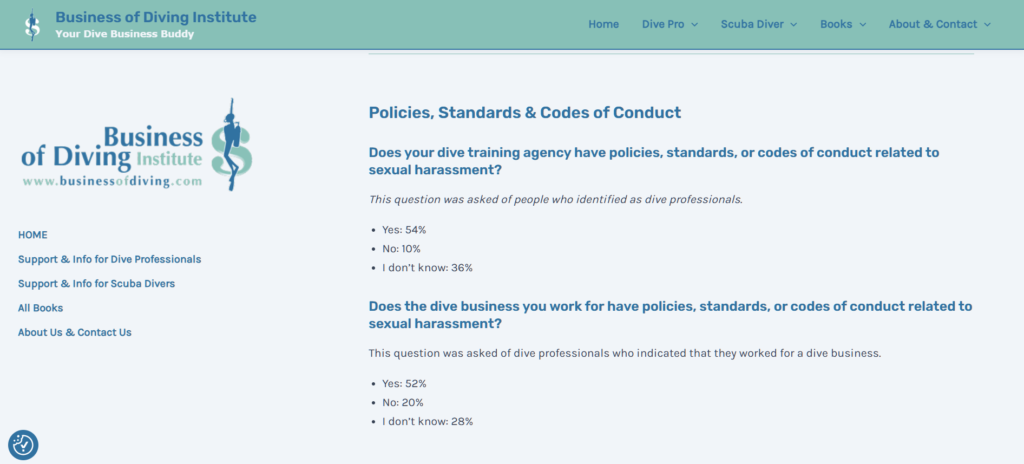
The survey also identified uncertainty around industry policies. Among responding dive professionals, 36% did not know whether their training agency had relevant policies or codes of conduct, while 28% of those working for dive businesses did not know whether their workplace had them.
That uncertainty matters.
A policy cannot offer much practical reassurance if staff and guests do not know where to find it, how to report a concern or what happens afterwards.
How Influencer-Led Expeditions Are Changing Dive Trip Safety
Not so long ago, most divers organised specialist trips through established dive centres, liveaboard companies or travel agencies.
Those options still exist, but social media has introduced another model.
An underwater photographer, marine wildlife creator or freediving personality builds an audience around extraordinary encounters and eventually begins hosting trips of their own.
The attraction is understandable.
Travellers may want to photograph whales alongside someone whose work they admire, explore remote reefs with an experienced filmmaker or learn specialist techniques from a recognised expert.
A well-run creator-hosted expedition can offer genuine value, particularly when the host contributes specialist knowledge and works with a competent local operator.
The concern begins when popularity is mistaken for professional accountability.
A creator may be excellent at photography, storytelling or building an online audience without having the operational experience to manage a commercial expedition.
Those are different skills.
Who is actually running the trip?
One of the most important questions is also one of the easiest to overlook.
Is the influencer:
- A guest host working alongside a licensed local operator?
- The person selling and contracting the entire package?
- A photographer accompanying an independently organised tour?
- The expedition leader responsible for guests and activities?
- Or a combination of these roles?
The answer affects who controls accommodation, payments, cancellations, diving arrangements and complaints.
A professionally operated trip should make these responsibilities clear before anyone pays a deposit.
If the marketing prominently features an influencer but the booking documents never identify the company responsible for delivering the trip, that deserves further investigation.
The Power Imbalance Behind Some Creator-Hosted Trips
Not every inappropriate relationship involves the same circumstances, and not every mentorship arrangement is exploitative.
However, the structure of certain trips can create significant imbalances.
Imagine an aspiring underwater photographer who has saved for months to join an expedition.
They admire the host, hope to build their portfolio and believe the trip might lead to professional opportunities.
Once they arrive, the host may influence where they stay, which activities they join, whether they receive photography opportunities and how they are represented online.
That is considerable influence over a paying guest or junior collaborator.
If the host begins crossing personal boundaries, the guest may feel that challenging them could jeopardise the entire experience.
When a free trip isn’t straightforward
Offers of complimentary travel, photography mentorship or accommodation in exchange for social media work are not automatically suspicious.
Many legitimate businesses use clearly defined work exchanges.
The problem arises when expectations are vague.
What exactly is being exchanged? Who provides accommodation? Who supervises the work? Can either party end the arrangement? What happens if a participant feels unsafe?
Without written terms, professional expectations can become difficult to separate from personal demands.
Professional access should never be conditional on accepting unwanted intimacy, inappropriate behaviour or unsafe accommodation.
Why remote locations increase vulnerability
Ocean expeditions frequently operate in places where independent transport, mobile reception and alternative accommodation are limited.
That remoteness is part of their appeal.
But it also means that leaving an uncomfortable situation may be more complicated than walking out of a hotel in a major city.
A guest might be staying aboard a vessel, on a remote island or at accommodation arranged entirely through the organiser.
For this reason, an expedition’s guest welfare procedures should be just as carefully considered as its dive sites and wildlife itinerary.
What are the biggest dive trip safety red flags?
The most important warning signs include unclear operator responsibilities, unexpected accommodation changes, inadequate complaint procedures, vague mentorship agreements, pressure to ignore personal boundaries, missing emergency plans and reliance on social media popularity rather than verifiable credentials.
None of these warning signs automatically proves misconduct, but each deserves closer investigation before committing to an expensive ocean expedition.
7 Dive Trip Safety Red Flags to Look for Before Booking
The following warning signs do not prove misconduct. They are reasons to ask more questions, request written clarification or reconsider whether an operator is suitable.
1. You cannot identify the company responsible for your trip
An Instagram account is not a substitute for clear booking documentation.
Before paying, you should know the legal business responsible for the trip, who receives your payment and who is delivering the activities.
If the organiser cannot clearly explain these relationships, ask why.
2. Accommodation arrangements are vague
A promise of private accommodation should be reflected in the booking agreement.
Confirm whether you have a private room, shared room or cabin, who you will share with, and whether accommodation has appropriate privacy and security.
An unexpected change that pressures you to share personal space with a host or staff member is a serious concern.
You should not be made to feel unreasonable for insisting on the accommodation you booked.
3. There is no independent way to report a problem
What happens if the person causing concern is also the expedition leader?
A safeguarding policy is much less effective when complaints can only be made to the individual being complained about.
Ask whether there is another designated contact, an escalation process or an independent company representative.
4. Free trips and mentorship offers have no written boundaries
If you are being offered travel, accommodation or professional exposure in return for work, ask for written terms.
These should identify the work required, expected hours, expenses, accommodation, supervision and arrangements for ending the agreement.
Professional mentorship should not depend on personal favours or access to someone’s private living space.
5. Organisers dismiss reasonable boundaries
Pay attention to how staff respond to ordinary questions.
Are they respectful when you ask about accommodation, privacy, safety or complaints?
Or do they mock your concerns, pressure you to be more relaxed or suggest that refusing an arrangement will affect your opportunities?
An operator’s response to a reasonable boundary can reveal a great deal about its working culture.
6. Operational safety procedures are unclear
Safeguarding and diving safety are separate responsibilities, but both should be taken seriously.
Before a scuba or freediving expedition, ask who supervises the activity, what qualifications are required, how emergencies are managed and what medical or evacuation arrangements exist.
For scuba diving, relevant questions include emergency oxygen availability, dive planning, guide ratios, buddy procedures and how the operation responds when conditions change.
The exact requirements depend on the activity, location and applicable standards.
We would be concerned by an operator that dismisses these questions rather than answering them.
7. The only evidence of credibility is social media popularity
A huge following can indicate that someone produces compelling content.
It does not independently establish that they operate safe expeditions.
Look beyond curated testimonials and attractive footage.
Verify the business, check relevant professional credentials, read independent feedback and understand the booking terms.
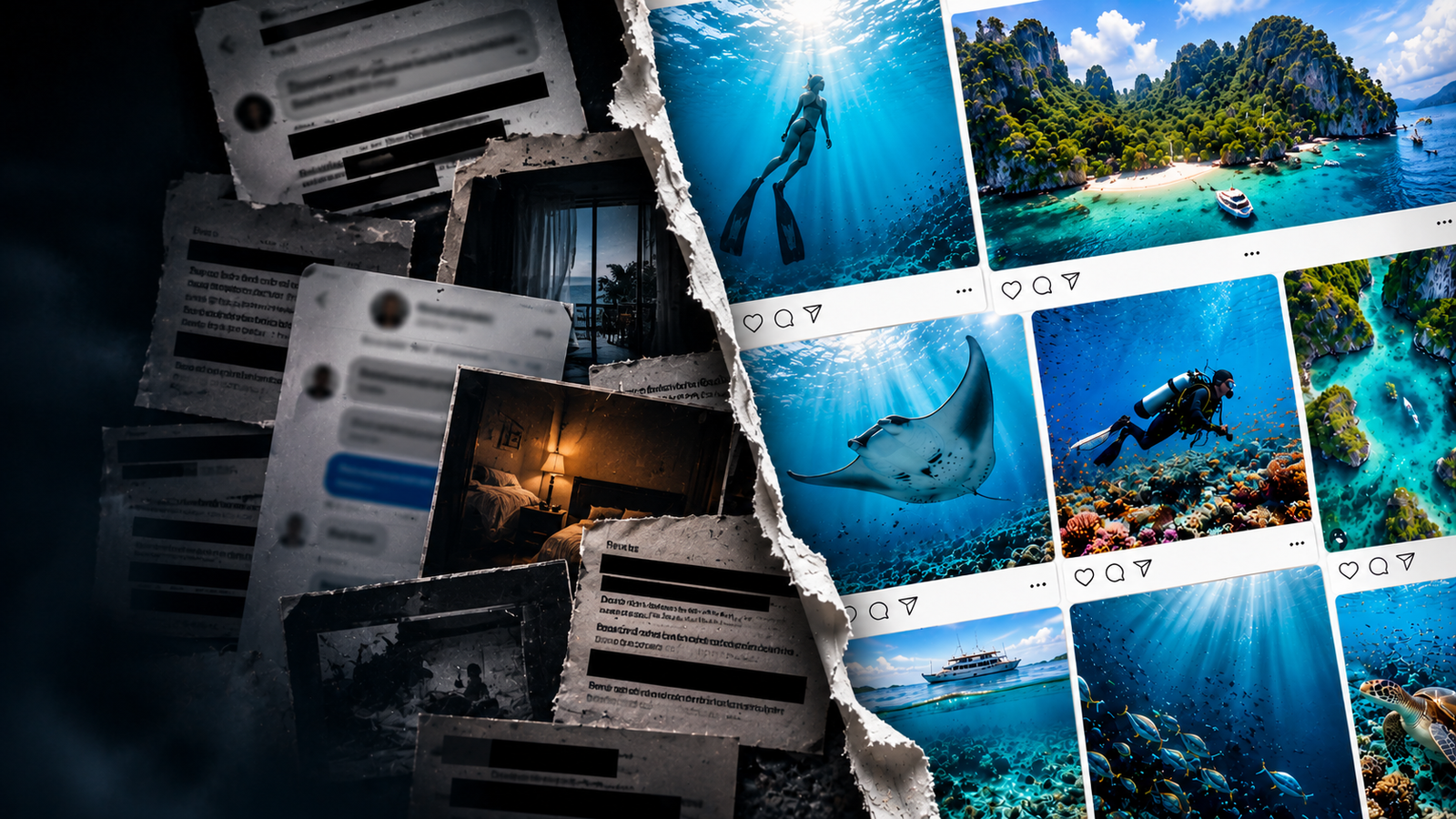
A beautiful Instagram feed tells you what a trip looks like. It does not necessarily tell you how the trip is run.
Dive Trip Safety Checklist: What to Verify Before Paying
We recommend treating an expensive expedition as a professional travel purchase, not simply an opportunity to meet someone you admire.
Here is a practical checklist.
What to check | What to ask |
Legal operator | Which company is responsible for the booking and delivering the trip? |
Licences and credentials | What local authorisations and professional qualifications apply? |
Activity supervision | Who leads the diving, freediving or wildlife encounters? |
Accommodation | What room or cabin is guaranteed, and with whom will I share? |
Payment terms | Who receives the deposit, and what are the cancellation and refund conditions? |
Guest welfare | Is there a written conduct policy and an alternative complaint contact? |
Emergency procedures | What medical, evacuation and emergency communication arrangements exist? |
Independent reviews | Can I find feedback beyond the host’s own social channels? |
Personal independence | What options would I have if I needed to leave early? |
Work exchanges | Are duties, expenses, accommodation and boundaries documented? |
Verify credentials independently
If someone advertises themselves as a PADI professional, for example, PADI provides consumer alerts identifying professionals and businesses that are not authorised to conduct its programmes.
Where possible, verify active professional status directly with the relevant training organisation rather than relying on a badge in someone’s biography.
Remember that qualifications for teaching scuba or freediving do not automatically establish competence to organise every type of wildlife expedition.
Research reviews carefully
Independent reviews can reveal recurring concerns about organisation, communication or accommodation.
However, anonymous allegations and forum comments should not be treated as proven facts.
Look for patterns, dates, first-hand detail and any documented response from the operator.
A serious complaint deserves attention, but responsible research also means distinguishing between an unresolved allegation, a customer service dispute and a confirmed regulatory or legal finding.
Have an independent exit plan
Before travelling somewhere remote, understand your options for leaving the trip.
That may mean having access to emergency funds, keeping copies of essential documents, knowing how to contact local transport providers or ensuring a trusted person has your itinerary.
These precautions are sensible travel planning.
They are not a substitute for the organiser’s responsibility to provide a safe environment, and someone who experiences harassment or assault is never responsible for another person’s misconduct.
What Should Dive Operators, Brands and Training Agencies Be Doing?
The current discussion raises questions not only about individuals but also about the systems surrounding them.
A professional expedition business should have clear standards governing staff behaviour, accommodation, reporting and complaints.
Guests should know who is responsible for their welfare.
Staff should understand how concerns are escalated.
And complaints should be assessed fairly, without automatically protecting someone because they bring commercial value or have a large audience.
Safeguarding is already part of professional diving
This is not an entirely new concept.
PADI published professional-conduct guidance in 2019 discussing sexual harassment and assault, the importance of respectful behaviour and the need to respond appropriately to complaints.
Its guidance recognises that diving safety includes emotional and psychological welfare, not simply avoiding physical diving accidents.
PADI Pros
Divers Alert Network’s business code of conduct also requires professional behaviour and explicitly prohibits harassment, intimidation and unwanted sexual advances.
Divers Alert Network
These standards provide a useful starting point.
The challenge is making sure expectations are communicated, applied and enforced.
What happens when someone holds multiple certifications?
One particularly important issue emerged in DeeperBlue’s 14 October reporting.
A diving or freediving professional may hold qualifications from several organisations.
If one agency restricts or removes its own credentials, that action does not automatically cancel credentials issued by another.
Molchanovs described efforts to improve communication between agencies, while FII acknowledged the limits of its authority over qualifications issued elsewhere.
This is a significant accountability question.
Training agencies must balance confidentiality, fairness, legal obligations and the protection of participants. But a system in which relevant safeguarding concerns remain isolated within separate organisations may leave gaps.
There is room for stronger cooperation, clearer reporting routes and transparent explanations of how professional-conduct cases are handled.
Brands have responsibilities too
When an equipment company partners with an influencer, it benefits from that person’s audience and reputation.
A brand cannot control every action of every collaborator.
However, it can establish conduct expectations, provide reporting routes, investigate concerns appropriately and decide whether a commercial relationship remains consistent with its standards.
The recent Molchanovs response illustrates the distinction between taking a commercial precaution and determining whether criminal misconduct occurred.
Those are different decisions, and public communication should make that clear.
Do You Actually Need an Influencer to Experience These Destinations?
One of the most persuasive aspects of creator-led travel is the suggestion that a particular host offers access to an experience you cannot arrange elsewhere.
Sometimes that is true.
Specialist photographers, researchers and expedition leaders may provide expertise or access that genuinely distinguishes their trips.
But not every whale encounter, shark expedition or remote dive destination requires booking through a social media personality.
Depending on the location, you may be able to arrange a comparable experience through an established dive centre, commercial liveaboard, specialist local operator or independent itinerary.
Each option has advantages and limitations.
Booking model | Potential benefits | Questions to consider |
Influencer-hosted expedition | Specialist host, community, photography opportunities | Who operates the trip and handles guest welfare? |
Established dive centre | Local knowledge, flexible day trips, direct operator contact | What standards, supervision and safety systems are in place? |
Commercial liveaboard | Integrated accommodation and diving, access to remote sites | How are cabins allocated, and who manages complaints? |
Independently planned trip | More control over accommodation and schedule | Can you coordinate reliable local operators and logistics? |
None is automatically safer or cheaper.
The right choice depends on the operator, destination, activities, guest requirements and total cost.
We’ve experienced how different booking models can change a dive trip. In our Komodo liveaboard versus day-trip comparison, for example, we explain the practical trade-offs between staying aboard a vessel and diving from a land-based centre.
The wider lesson applies here too: compare what you are actually buying, not just how attractive the experience looks online.
What to Do If Something Goes Wrong on a Dive Trip
If you experience harassment, coercion or assault while travelling, your immediate safety and wellbeing matter more than preserving the trip, protecting someone’s reputation or avoiding an uncomfortable conversation.
Depending on the circumstances, you may wish to:
- Move somewhere you feel safer and contact a trusted person.
- Seek medical attention, including specialist sexual assault care where available.
- Contact your embassy, consulate or travel insurer if you need assistance abroad.
- Preserve relevant messages, booking records or other information if you feel able to do so safely.
- Contact a specialist support organisation to discuss your options.
- Report the incident to the operator, training agency or authorities if you choose and it is safe to do so.
Reporting to police is a personal decision and may involve different practical or legal considerations depending on the country.
You do not need to make an immediate decision about formal reporting to deserve support.
Confidential support resources
For people seeking specialist help, the following organisations provide support or help identify services:
- International: NO MORE Global Directory — services in more than 200 countries.
- United States: RAINN National Sexual Assault Hotline — confidential support and information.
- United Kingdom: Rape Crisis England & Wales — specialist sexual violence support.
Services, availability and confidentiality arrangements vary by location. If you are in immediate danger, contact the appropriate local emergency service.
Final Thoughts: The Ocean Should Be a Place of Trust
We spend our lives encouraging people to explore the underwater world.
We know how much confidence it takes to travel somewhere unfamiliar, join a group of strangers or trust someone else to lead you into the ocean.
That trust should never be taken for granted.
The allegations being discussed within the ocean community deserve careful, fair investigation. People reporting harm deserve to be heard and supported. People facing accusations deserve appropriate processes that distinguish allegations from established findings.
And the businesses profiting from ocean tourism should be prepared to demonstrate that guest welfare is more than a line in their marketing.
The answer is not to stop travelling, stop diving or assume that every influencer-led expedition is unsafe.
It is to expect better transparency, stronger professional boundaries and meaningful accountability.
A large audience is not a safety qualification. And nobody’s influence should place them above the standards expected of every other dive professional or travel operator.
The ocean should remain a place of adventure, discovery, freedom and mutual respect.
Let’s make sure the way we organise our expeditions reflects that.
Ultimately, improving dive trip safety means recognising that guest welfare, professional boundaries and accountability matter just as much as what happens underwater.
— Aaron & Cassie
FREQUENTLY ASKED QUESTIONS
Are influencer-led dive trips safe?
Many influencer-led expeditions are run professionally and offer excellent experiences. Safety depends on the actual operator, qualified supervision, accommodation arrangements, emergency procedures and guest welfare standards — not the host’s follower count.
What are the biggest red flags when booking a dive trip?
Unclear operator identity, vague accommodation arrangements, missing complaint procedures, pressure to accept uncomfortable situations, unexplained safety concerns and an absence of independent reviews all warrant further investigation.
How can I check whether a dive instructor is qualified?
Ask which organisation issued their certification and verify their current professional status directly with that organisation. For PADI professionals, published consumer alerts can help identify individuals or businesses that are no longer authorised to offer PADI programmes.
What should I do if a dive expedition changes my accommodation?
Ask the organiser to explain the change and confirm the alternatives in writing. You should not feel pressured to share a bed or private personal space with a host or staff member. If you feel unsafe, prioritise finding appropriate accommodation and contacting someone you trust.
Can I report sexual harassment involving a dive professional?
You can contact the relevant dive training agency, expedition operator or specialist support organisation. Depending on the circumstances and jurisdiction, reporting to local authorities may also be an option. You can seek confidential support before deciding whether to make a formal report.