Scuba Diving Downcurrents: How to Recognise, Escape & Survive a Vertical Current
Downcurrents are one of the most feared environmental hazards in recreational scuba diving — and one of the most misunderstood.
A powerful vertical current can change your depth rapidly, increase your gas consumption, separate you from your group and trigger panic in seconds. But not every downcurrent is an underwater vortex, and many divers have probably experienced mild vertical water movement without even realising it.
Having taught and dived in some of the world’s best-known strong-current destinations — including Komodo, Raja Ampat and the Maldives — we’ve seen first-hand how quickly unexpected water movement can unsettle even experienced divers.
The good news?
Understanding why downcurrents happen, how to recognise the warning signs and what to do if you’re caught in one can dramatically improve your ability to respond calmly.
This guide explains the physics, the warning signs and a graded emergency response — including what changes if you’re pulled away from the reef into open blue water.
Safety note: This guide is educational and does not replace formal training, a site-specific briefing or the judgement of an experienced local dive professional. Downcurrents vary enormously in strength, width, depth and behaviour. Always dive within your training, experience and personal limits.
Quick Answer: What Should You Do If You’re Caught in a Downcurrent?
If a downcurrent starts pulling you deeper:
- Stay calm and immediately monitor your depth.
- Equalise continuously as your depth increases.
- Avoid exhausting yourself trying to swim vertically against powerful moving water.
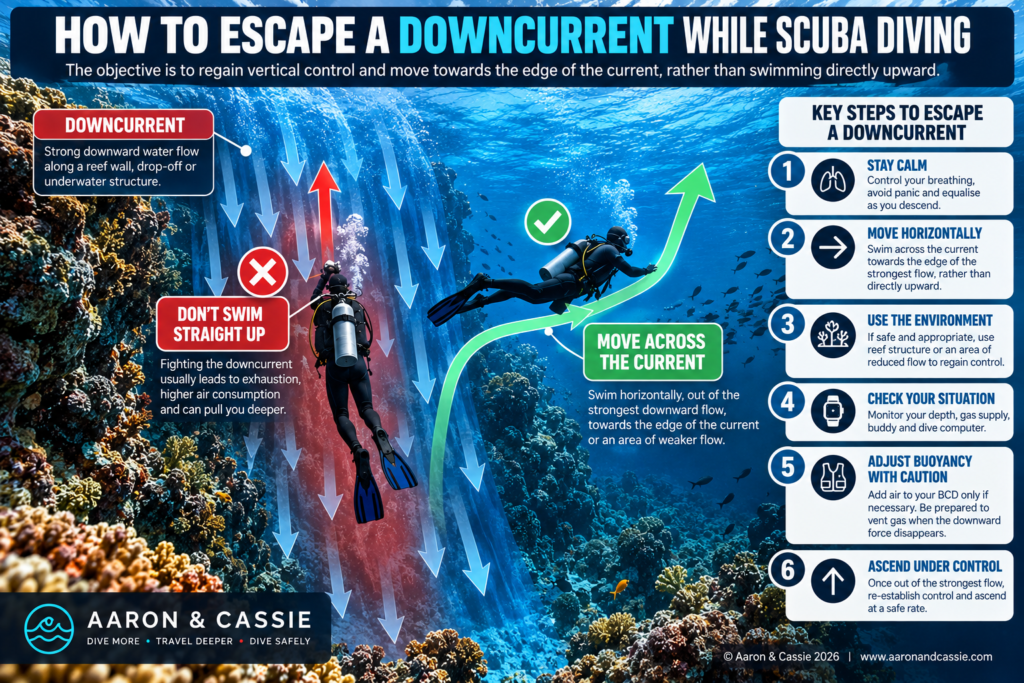
- Move horizontally or diagonally across the current towards its edge while maintaining vertical control.
- Use suitable solid substrate for stability if conditions make that necessary and it can be done safely.
- Monitor your gas supply and dive computer continuously.
- Use additional BCD buoyancy cautiously if the current cannot otherwise be escaped, remembering that exiting the flow while strongly positively buoyant could cause a rapid ascent.
There is no single manoeuvre guaranteed to work in every downcurrent. Your response should escalate according to the strength of the current, your depth, gas supply, topography and ability to maintain control.
Downcurrent Diving: Quick Safety Guide
| Situation | What You May Notice | Priority |
|---|---|---|
| Mild downcurrent | Gradual unexpected descent | Adjust position and move out of the flow |
| Strong downcurrent | Rapid depth increase, unusual bubbles | Stay calm, equalise, move across the flow |
| Current beside a wall | Divers/fish angled against vertical flow | Follow the guide and use topography intelligently |
| Severe downcurrent | Kicking does not stop descent | Seek controlled stability and escape laterally |
| Swept into blue water | No reef reference, continuing descent | Monitor depth closely and use controlled buoyancy if required |
| Leaving the current | Sudden reduction in downward force | Be ready to vent expanding BCD gas and control ascent |
| Separated from group | No visual contact with guide/buddy | Follow the pre-briefed separation procedure and prepare your DSMB |

What Is a Downcurrent in Scuba Diving?
A downcurrent, sometimes called a downdraft, downwelling or vertical current, is water moving downward through the water column rather than predominantly horizontally along a reef.
Most ocean currents encountered by recreational divers move horizontally.
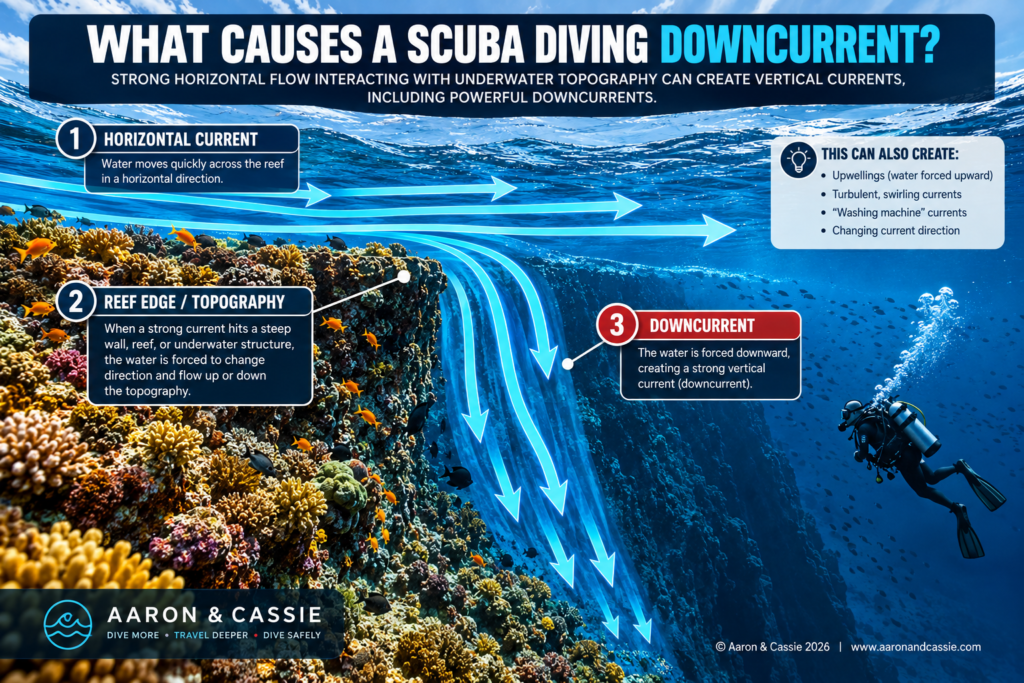
But when moving water interacts with underwater topography — particularly steep walls, pinnacles, drop-offs, channels and reef edges — its direction can change.
If water is deflected downward, divers caught within that moving water can descend with it.
And unlike a dramatic whirlpool at the surface, you usually cannot see a downcurrent itself.
You see what it does.
Your depth begins increasing.
Your ears suddenly need equalising.
Your bubbles behave strangely.
The divers ahead change their body position.
Fish point upwards along the reef.
Soft coral bends sharply with the water.
Learning to read those clues is one of the most useful skills you can develop when diving in strong currents.
What Causes Downcurrents Underwater?
Think of current as a river moving through the ocean.
When that moving water encounters a solid obstacle, it has to go somewhere.
A reef wall, underwater pinnacle or island can force the flow:
- around the structure;
- over it;
- upwards;
- downwards;
- or into turbulent eddies behind it.
When strong horizontal flow is redirected down a steep reef face or underwater structure, a localised downcurrent can form.
This is why vertical currents are particularly associated with:
- steep walls;
- pinnacles;
- seamounts;
- reef corners;
- channels;
- drop-offs;
- overhangs;
- and complex underwater topography.
Currents can also interact with one another. Where different flows converge, divers may encounter rapidly changing movement that feels far less predictable.
What Is a “Washing Machine” Current?
“Washing machine” isn’t a precise scientific classification.
It’s diver shorthand for turbulent water where the direction of movement changes quickly — potentially involving horizontal current, downwelling, upwelling and eddies.
If you’ve experienced one, you’ll understand the name.
You may feel yourself moving down, sideways and then upwards within a relatively small area.
Your bubbles may swirl around you rather than rising neatly towards the surface.
Your orientation can become confusing.
And other divers may suddenly appear to be moving in completely different directions.
The important lesson isn’t memorising the terminology.
It’s recognising that current is three-dimensional.
Water doesn’t only move left and right.
It moves over, under and around underwater terrain.
Downcurrent vs Upcurrent: What’s the Difference?
| Current | Water Movement | Main Risk |
|---|---|---|
| Horizontal current | Across the dive site | Separation, exhaustion, missed exit |
| Downcurrent / downwelling | Towards greater depth | Rapid descent, gas use, narcosis/decompression exposure |
| Upcurrent / upwelling | Towards shallower water | Rapid or uncontrolled ascent |
| Turbulent / “washing machine” current | Multiple changing directions | Disorientation and loss of depth control |
The response to an upcurrent is therefore not identical to the response to a downcurrent.
This guide focuses primarily on downcurrents, but the bigger skill is learning to recognise changing water movement before it takes control of your depth.
Where Are Downcurrents Most Likely?
Vertical currents can occur anywhere the right water movement and underwater topography combine.
They’re particularly relevant at strong-current destinations such as:
Komodo National Park
Komodo’s narrow passages, islands, pinnacles and enormous tidal exchanges can produce exceptionally dynamic diving.
Sites such as Batu Bolong, Castle Rock and The Cauldron are famous partly because of the water movement around them.
We’ve spent considerable time diving Komodo, and one of the biggest lessons is that the same site can behave very differently depending on the tide and conditions.
That is exactly why experienced local guides matter.
Read Next: Diving Komodo National Park: The Complete Guide to Indonesia’s Most Thrilling Dive Destination
Raja Ampat
Raja Ampat’s channels and exposed pinnacles can also produce strong horizontal currents, back eddies and vertical water movement.
The nutrient-rich currents help create the spectacular biodiversity divers travel there to see — but they demand good buoyancy, situational awareness and respect for local briefings.
Read Next: Scuba Dive Raja Ampat: Luxury Resort or Local Homestay?
The Maldives
The Maldives is famous for current diving through channels between reefs and atolls.
Conditions vary enormously, but strong water movement around channel edges, reef corners and drop-offs means current awareness should be part of every diver’s preparation.
Read Next: Is Diving in the Maldives Dangerous?
Nusa Penida
Nusa Penida’s steep underwater topography and oceanic exposure can produce powerful and changing currents.
It is also a good reminder that a beautiful, familiar dive destination can still contain advanced environmental conditions.
Cozumel, Palau and Other Drift-Diving Destinations
Strong currents are not unique to Indonesia or the Maldives. Vertical water movement can occur wherever moving water meets suitable topography.
The location doesn’t determine whether a dive is safe.
The conditions on that particular dive do.
How to Spot a Downcurrent Before You’re Caught in It
This is arguably more valuable than knowing how to escape one.
The faster you recognise changing water movement, the less likely you are to find yourself reacting after control has already been lost.
1. Watch the Divers Ahead of You
Your guide can effectively become a human current indicator.
Pay attention to:
- body angle;
- finning effort;
- direction of travel;
- sudden depth changes;
- and whether they begin sheltering behind topography.
On wall dives we’ve often found ourselves adjusting our angle constantly as the water changes.
Sometimes current diving feels almost like a dance with the reef.
If the experienced guide ahead suddenly changes position, don’t blindly continue into the water they just reacted to.
Watch first.
2. Watch the Bubbles
Bubbles are one of our favourite current indicators because their normal behaviour is so familiar.
They should rise.
If you see bubbles:
- travelling strongly sideways;
- streaming ahead of divers;
- circling around someone’s head;
- being swept across the reef;
- or appearing to move downwards;
the surrounding water is moving in a way worth paying attention to.
Look beyond your own bubbles too.
The divers 5–10 metres ahead can effectively show you what the water is doing before you reach it.
3. Watch the Fish
Fish spend their lives responding to moving water.
Use them.
Reef fish commonly orient themselves into current. If fish along a wall are noticeably angled upwards, that can indicate water travelling down the reef face.
Large pelagic fish can also reveal current strength.
If powerful swimmers such as jacks or barracuda appear to be working unusually hard to hold position, don’t assume you’ll fare better wearing a BCD and carrying a cylinder.
Sometimes the most useful clue is where the fish aren’t.
4. Watch Soft Coral and Suspended Particles
Soft corals can make water movement visible.
If they’re being pressed unusually flat against the reef, current is likely stronger than it initially appears.
Sand, plankton and suspended particles can also reveal water moving vertically or around reef structures.
5. Watch Your Depth — Not Just the Scenery
This sounds obvious.
Yet in a beautiful dive destination, it’s surprisingly easy to become distracted by sharks, mantas, photography or the reef itself.
A depth change you didn’t initiate is information.
If you’re suddenly equalising repeatedly despite believing you’re maintaining depth, check your computer immediately.
What to Do in a Downcurrent: Our 5-Step Response
There is an important caveat before we begin:
There is no universal five-step manoeuvre that solves every downcurrent.
A mild vertical flow beside a reef and a violent downwelling carrying a diver into open blue water are completely different scenarios.
Think of the following as a graded decision framework, not an underwater recipe.
Step 1: Stay Calm and Recognise What Is Happening
Your ears squeeze.
The reef appears to be moving upwards.
Your depth number is increasing.
Your bubbles aren’t behaving normally.
Your first job is not to overpower the ocean.
It’s to recognise the problem without allowing surprise to become panic.
Panic causes:
- rapid breathing;
- increased gas consumption;
- poor buoyancy decisions;
- tunnel vision;
- excessive physical effort;
- and loss of situational awareness.
Keep breathing.
Equalise as required.
Find a visual reference if one exists.
Check your depth.
Then act deliberately.
Step 2: Stop the Uncontrolled Descent
The goal isn’t necessarily to immediately reach your previous depth.
The immediate goal is to regain vertical control.
One of the most intuitive reactions is to point straight at the surface and kick as hard as possible.
But imagine being caught in a fast-flowing river.
Trying to swim directly upstream can exhaust you while barely changing your position.
Moving across the flow towards its edge may require dramatically less effort.
With a downcurrent, that can mean swimming horizontally or diagonally out of the affected zone while simultaneously trying to prevent further descent.
Your exact escape direction depends on the shape of the flow and surrounding topography, so there isn’t a universal “45-degree rule”.
The principle is:
Escape the moving water rather than trying to overpower the entire body of it.
Step 3: Use the Environment for Control — When Appropriate
Topography can create areas of reduced flow.
Large reef structures, rocks and changes in terrain may produce a current shadow where the water is less powerful.
Experienced current divers learn to recognise and use these areas rather than unnecessarily fighting open water.
However, there’s an important distinction:
“Stay close to the reef” is not a universal downcurrent rule.
Sometimes the wall itself is where the downward flow is concentrated.
Your priority is therefore to understand where the current is going and move towards the safest available edge or area of reduced flow.
If the downcurrent is severe and you cannot maintain control, making contact with suitable solid, non-living substrate may become necessary in an emergency.
Protecting coral should always matter.
But protecting human life comes first.
Avoid grabbing living coral, fragile organisms or anything that could injure you.
Step 4: Check Your Depth, Gas and Dive Computer
Once you have enough control to think clearly, assess your situation.
Check your depth
How far have you descended?
Check your gas
How much breathing gas remains?
Remember that your gas consumption increases as ambient pressure increases with depth — and strenuous finning can accelerate consumption further.
Check your computer
What are your:
- no-decompression limits;
- ascent requirements;
- maximum depth;
- and current depth?
Check your buddy and guide
Are they affected too?
Where are they moving?
Can you remain together?
This is why good situational awareness matters before an emergency ever occurs.
Step 5: Exit the Flow and Make a Controlled Ascent
Once you’ve moved out of the strongest downcurrent, resist the temptation to race towards the surface.
Re-establish control.
Check your buoyancy.
Check your computer.
Check your buddy.
Then ascend at an appropriate controlled rate.
If you’ve added air to your BCD at depth, remember that the gas will expand as you ascend.
That becomes especially important when you leave the downward-moving water.
The force that was holding you down may suddenly disappear while your BCD remains positively buoyant.
Be prepared to vent expanding gas early and maintain ascent control.
Should You Inflate Your BCD in a Downcurrent?
This deserves its own section because online advice is often far too simplistic.
The short answer:
Not automatically.
Adding large amounts of air to your BCD as your first reaction can create another emergency.
Imagine becoming strongly positively buoyant while the current is holding you down.
You then escape the downcurrent.
Suddenly the downward force disappears.
You’re now ascending, your BCD gas is expanding, and your positive buoyancy is increasing.
That can develop into a runaway ascent.
A more sensible approach is graded:
Mild current: maintain control and move out of it.
Stronger current: swim across the flow while controlling depth.
Severe current: use suitable topography for stability where possible.
Extreme situation where descent cannot otherwise be arrested: carefully controlled additional buoyancy may become necessary.
If you add gas, monitor your depth continuously and be ready to dump it as soon as your ascent begins.
Should You Drop Your Weights in a Downcurrent?
Generally, not as an early response.
Dropping your weights can produce a major and potentially irreversible increase in positive buoyancy.
If you subsequently leave the downcurrent, controlling the resulting ascent may become extremely difficult.
Weight ditching remains an emergency procedure and circumstances can exist where establishing positive buoyancy is necessary for survival.
But it shouldn’t be confused with the routine first response to encountering vertical current underwater.
What If the Downcurrent Pulls You Away From the Reef?
This is one of the scenarios that concerns us most.
Near topography you may have:
- visual references;
- clues to current direction;
- potential current shadows;
- your guide;
- and, in an extreme situation, solid substrate for stability.
In open blue water those references can disappear.
You may be surrounded by nothing but blue.
That makes your computer and bubbles particularly important.
If you’re continuing to descend despite attempting to swim out of the flow, controlled buoyancy adjustment may become necessary.
Add gas incrementally rather than treating the inflator like an emergency launch button.
Continue monitoring depth.
And anticipate what happens when you finally leave the current:
the downward force can disappear abruptly.
Be ready to vent your BCD and control the ascent.
If you become separated from the group, follow the lost-diver procedure established during your briefing.
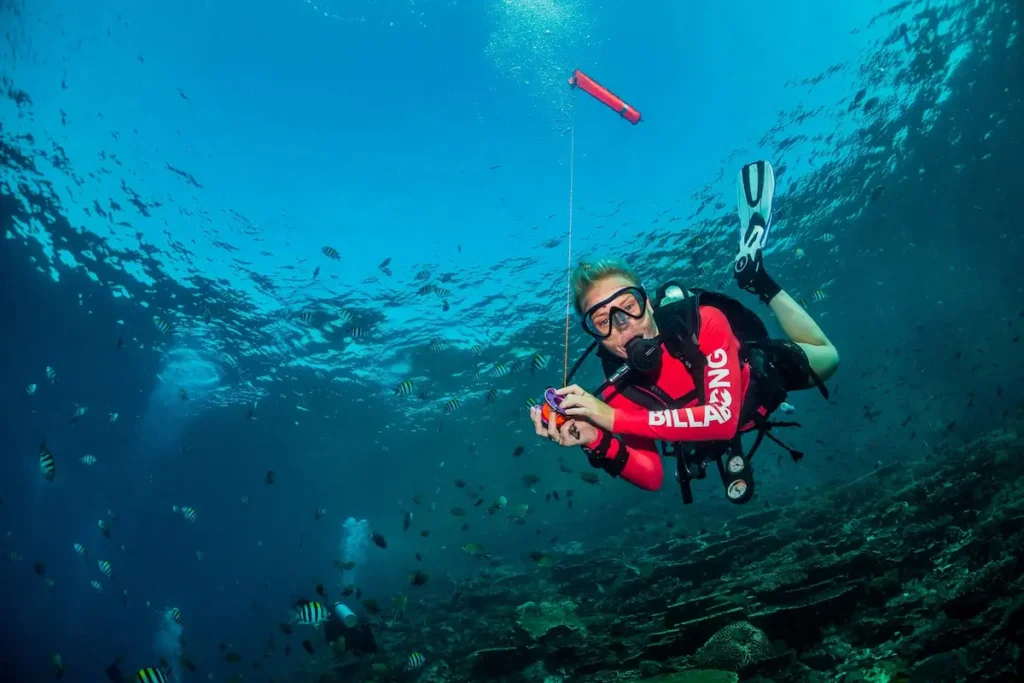
This is also exactly why we believe divers visiting strong-current destinations should carry appropriate surface signalling equipment.
The 7 Biggest Downcurrent Mistakes
| Mistake | Why It Matters | Better Principle |
|---|---|---|
| Panicking | Increases breathing and destroys decision-making | Stop, breathe and assess |
| Swimming only straight upwards | Can waste huge amounts of energy | Move towards the edge of the flow |
| Immediately filling the BCD | Can create a runaway ascent later | Use a graded response |
| Ignoring ear pressure | Rapid descent can cause barotrauma | Equalise early and continuously |
| Forgetting gas | Depth + exertion increases consumption | Check pressure frequently |
| Losing awareness of the guide | Removes a valuable current reference | Observe guide position and behaviour |
| Diving beyond your experience | Reduces your margin for error | Build current experience progressively |
What Does a Downcurrent Actually Feel Like?
One reason downcurrents frighten divers is that the first sensation can be surprisingly subtle.
You may not feel yourself being violently “sucked” down.
Instead:
You notice you’re equalising again.
Then again.
You glance at your computer.
You’ve descended several metres.
The reef beside you appears to be moving upwards.
Your breathing gets heavier because you’ve unconsciously started kicking harder.
Then you notice the bubbles.
Instead of rising neatly above the divers ahead, they’re being stretched sideways through the water.
That moment — when your brain realises “I’m not controlling my depth anymore” — is where calm decision-making becomes incredibly important.
We’ve seen how quickly unexpected current can induce stress in divers, including experienced ones. That’s why we believe learning to read moving water is just as important as memorising an emergency response.
How to Prepare for Diving in Strong Currents
The best downcurrent strategy begins before entering the water.
Listen to the Dive Briefing
A good strong-current briefing should cover:
- expected current direction;
- entry technique;
- likely current changes;
- areas to avoid;
- maximum depth;
- group positioning;
- separation procedure;
- ascent procedure;
- DSMB protocol;
- and boat pickup procedure.
If something isn’t clear, ask.
Know Your Equipment
You should be able to locate and operate without hesitation:
- BCD inflator;
- BCD dump valves;
- pressure gauge;
- dive computer;
- alternate air source;
- DSMB and reel/spool.
A strong current is a terrible place to discover that you don’t know where the lower dump valve on a rental BCD is located.
Read Next: 7 Cheap Scuba Safety Items Every Diver Should Own
Carry Appropriate Surface Signalling Equipment
At a minimum, current divers should understand how and when to use a DSMB and spool.
Depending on the location and dive plan, additional visual, audible or electronic signalling equipment may also be appropriate.
The problem doesn’t necessarily end when you reach the surface.
A diver who surfaces in strong current can travel a considerable distance while a boat searches for them.
Build Current Experience Gradually
Don’t make one of the world’s most advanced current dives your introduction to moving water.
Progress from:
gentle drift dives → moderate current → more complex current diving
while developing:
- buoyancy;
- trim;
- finning;
- DSMB deployment;
- gas awareness;
- situational awareness;
- and confidence.
There is no shame whatsoever in sitting out a dive.
We’ve worked in places where conditions can transform dramatically between tides.
Sometimes the most experienced decision is simply:
Not today.
Essential Equipment for Strong-Current Diving
| Equipment | Why It Matters |
|---|---|
| Dive computer | Immediate depth and ascent information |
| DSMB + spool | Marks your position during ascent |
| Whistle | Audible surface signalling |
| Visual signalling device | Helps boats locate you |
| Cutting tool | Entanglement emergencies |
| Appropriate fins | Efficient propulsion when needed |
| Exposure protection | Important if a surface wait becomes prolonged |
| Personal locator where appropriate | Additional surface emergency signalling |
Equipment does not compensate for poor judgement.
But the right equipment, combined with training and good decision-making, increases your options when something goes wrong.
Click here to read the full details and get our equipment recommendations
Dive & Travel Insurance for Strong-Current Destinations
Even with good training, experienced guides and careful planning, diving still involves risks that can’t be completely eliminated.
That becomes particularly relevant when travelling to remote diving destinations such as Komodo, Raja Ampat or the Maldives, where an incident may involve boat evacuation, emergency medical care or transport to a facility capable of treating a diving-related injury.
For us, insurance is simply another part of preparing for a dive trip — alongside carrying a DSMB, checking our equipment and listening properly to the briefing.
| Cover | Why We Use It | Best For |
|---|---|---|
| DAN Dive Accident Insurance | Specialist cover designed around diving accidents and their associated treatment | Divers wanting dedicated dive accident protection |
| SafetyWing Travel Insurance | Broader travel medical insurance for life outside the water while travelling internationally | Dive travellers, long-term travellers and digital nomads |
DAN Dive Accident Insurance

As professional divers, DAN is our choice for dedicated dive accident insurance.
A diving emergency can involve specialist treatment that ordinary travel insurance isn’t necessarily designed around, particularly where hyperbaric treatment or evacuation is required. That’s why we prefer having diving-specific protection rather than assuming a general travel policy will cover every diving scenario.
SafetyWing Travel Insurance

Dive insurance and travel insurance aren’t necessarily the same thing.
We also use SafetyWing for broader travel protection while we’re overseas. That’s relevant for the many things that can happen on a dive trip that have nothing to do with decompression sickness or a diving accident — from illness and injury to other eligible travel-related problems.
For long trips in particular, we like separating the question of “are we protected for a diving accident?” from “are we protected while travelling?”
Affiliate disclosure: We may earn a commission if you purchase through our SafetyWing link, at no additional cost to you.
Important: Insurance policies, exclusions and eligibility can change. Always read the current policy wording yourself and confirm that your planned diving activities, destination, depth and certification level are covered. Never rely solely on a recommendation from a dive operator, blog or content creator when choosing insurance.
Our Approach
For our own travels, we don’t think of DAN vs SafetyWing as necessarily an either/or decision.
They serve different purposes.
DAN = diving-specific accident protection.
SafetyWing = broader travel protection.
What makes sense for you depends on your trip, existing insurance and the current terms of each policy.
Diving in Strong Currents: When Should You Abort?
Abort or decline a dive when:
- conditions exceed your experience;
- you’re uncomfortable with the briefing;
- you’re not confident deploying your DSMB;
- your buoyancy isn’t currently reliable;
- you’re fatigued or unwell;
- you don’t understand the entry or exit;
- the operator’s procedures concern you;
- or you simply don’t feel comfortable.
You don’t need to justify calling a dive.
A certification card tells you what you’ve been trained to do.
It doesn’t obligate you to do it.
The Most Important Downcurrent Skill Isn’t Strength
It’s awareness.
The strongest diver in the group cannot overpower an unlimited volume of moving ocean.
But an observant diver can notice:
the guide changing position;
the fish facing differently;
the soft coral flattening;
the bubbles being swept sideways;
their ears beginning to squeeze;
their depth starting to change.
Those extra seconds matter.
Downcurrents shouldn’t be treated as supernatural underwater monsters.
But they shouldn’t be dismissed either.
Understand them.
Build your experience progressively.
Listen to the people who know the dive site.
Carry the right safety equipment.
And never allow pride, a certification level or the number of dives in your logbook to convince you that conditions can’t exceed your limits.
The ocean always gets the final say.
Watch: How to Survive a Downcurrent
In our video, we use real underwater footage to show how bubbles and divers behave in strong vertical current and visually demonstrate the five-step response explained above.
Frequently Asked Questions About Scuba Diving Downcurrents
Can a downcurrent pull a scuba diver to the bottom?
A strong downcurrent can cause a rapid and potentially significant increase in depth, but downcurrents are not necessarily continuous columns extending indefinitely to the seabed. Their size and behaviour depend on water movement and topography. The immediate priority is recognising the descent and regaining vertical control before depth, gas consumption and decompression exposure become more serious problems.
Can you swim out of a downcurrent?
Often, yes. Moving horizontally or diagonally towards the edge of the affected flow can be more effective than trying to swim directly upwards against it. However, every downcurrent is different, and the appropriate response depends on its strength, width, depth and surrounding terrain.
Should you swim straight up in a downcurrent?
Trying to overpower a strong downcurrent by swimming vertically can cause rapid exhaustion and increased gas consumption. A better principle is to maintain vertical control while attempting to move across and out of the strongest flow.
Should you inflate your BCD in a downcurrent?
Not automatically. Excessive positive buoyancy can create an uncontrolled ascent when you leave the downcurrent. Buoyancy should be managed deliberately, with additional gas used cautiously when necessary rather than as an automatic first response.
Why do bubbles sometimes go down in a downcurrent?
Bubbles remain buoyant, but sufficiently strong downward-moving water can carry them downward or sideways faster than their natural buoyant rise through the surrounding water. Unusual bubble behaviour is therefore a useful visual clue that the water around you is moving vertically or turbulently.
Are downcurrents the same as rip currents?
No. A rip current is primarily a surface phenomenon transporting water away from shore. A scuba downcurrent or downwelling involves vertical movement within the water column. The useful analogy is that fighting directly against powerful moving water can be less effective than moving across the flow towards its edge.
Where are downcurrents most common?
They are particularly associated with strong-current areas containing walls, pinnacles, drop-offs, channels and complex topography. Famous current-diving destinations include Komodo, Raja Ampat, the Maldives, Palau and Cozumel.
What is an upcurrent?
An upcurrent or upwelling is water moving upwards through the water column. For a diver, its major danger is an unintended rapid ascent. Maintaining depth awareness and buoyancy control is essential.
Can experienced divers get caught in downcurrents?
Absolutely. Experience improves awareness and response, but it doesn’t remove environmental hazards. Strong vertical currents can surprise experienced divers too, particularly at unfamiliar sites or when conditions change.
Are downcurrents predictable?
Sometimes. Experienced local operators may know where vertical currents commonly form and how tides influence particular dive sites. But currents can vary, which is why a current briefing and real-time assessment remain important.
Want to Get Better at Diving in Current?
READ NEXT: What Is Drift Diving? A Beginner’s Guide to Diving in Current
If you’re planning a destination such as Komodo, Raja Ampat or the Maldives, start with the fundamentals of reading and moving with current before progressing to more demanding conditions.
READ NEXT: Is Komodo Diving Dangerous? Safety, Currents & How to Prepare
See how these principles apply in one of the world’s most exciting current-diving destinations.
READ NEXT: 7 Cheap Scuba Safety Items Every Diver Should Own
From DSMBs to surface signalling equipment, these are the small pieces of equipment we don’t like diving without.
READ NEXT: How to Equalise When Scuba Diving
Downcurrents can increase depth unexpectedly, making good equalisation technique particularly important.
About the Authors
Cassie Foley – PADI MSDT & SSI OWSI
Cassie is a professional scuba instructor and underwater filmmaker who has taught and dived extensively across current-heavy destinations in Southeast Asia and the Indian Ocean, including Komodo, Raja Ampat, Indonesia and the Maldives.
Together with her partner Aaron, she runs Aaron & Cassie, creating first-hand dive travel guides, underwater films and practical scuba education based on years of working within the dive industry.
Their goal isn’t to make challenging diving sound frightening — it’s to help divers understand the environments they’re entering so they can make better-informed decisions underwater.